

Open Horizon Reaches LF Edge Impact Stage 3: What It Means for Edge AI
By Joe Pearson, TSC Chair, Open Horizon (LF Edge)
Open Horizon has reached LF Edge Stage 3 (Impact Stage), the highest maturity level in the LF Edge Project Lifecycle. This milestone reflects the project’s evolution into a mature, production-ready platform supported by a diverse community of contributors and organizations. Today, Open Horizon helps users manage edge workloads at scale across cloud, on-premises, and edge environments, positioning the project to play an important role of leading Edge AI deployment and lifecycle management at scale.
The journey Open Horizon has taken within LF Edge to reach Stage 3 (Impact Stage) feels less like a finish line and more like an inflection point. It is a recognition that the simple community-built solution for managing edge workloads has matured into something lasting: multi-organizational and genuinely useful to people deploying distributed applications to the cloud, on-premises, and far edge.
Here’s what this milestone means, why it matters, and where Open Horizon is headed next.
What is Open Horizon?
Open Horizon is an open source platform, hosted under LF Edge (Linux Foundation), for deploying and managing containerized workloads and AI agents across distributed edge environments, including cloud, on-premises, and far-edge (disconnected) nodes. It provides policy-based automation for workload placement, lifecycle management, and secure software distribution at scale.
What Stage 3 Actually Represents
What is LF Edge Impact Stage?
Impact Stage (Stage 3) is the highest tier in the LF Edge Project Lifecycle. It is reserved for projects that operate on a self-sustaining cycle of development, maintenance, and long-term support, and are widely used in production environments with significant documented adoption. Requirements include a healthy diverse community, formal governance, a strong security posture, interoperability with other ecosystem projects, and verified production use cases.
The LF Edge Project Lifecycle defines Impact Stage as the level reserved for projects “on a self-sustaining cycle of development, maintenance, and long-term support” that are “widely used in production environments with a significant number of public use cases.” Reaching this stage requires more than good code. It demands a healthy, diverse community, documented governance, a strong security posture, demonstrated interoperability with other projects in the ecosystem, and verifiable production adoption.
That bar is intentionally high. And I’m proud to say Open Horizon has met it.
How We Got Here
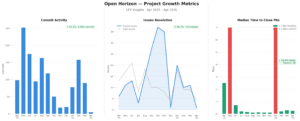
Over the past year, Open Horizon has grown in ways that speak directly to what Stage 3 is meant to recognize.
A broader, more diverse governing body. Our TSC now includes seven members spanning four partner organizations — AccuKnox, Anylog, IBM, and Mainsail Industries. Deliberately reducing IBM’s share of voting leadership in the project was a goal we set, and we’ve delivered on it. As experience has shown, an open-source project that can stand on its own across multiple organizations is a project that can last.
Real-world adoption is accelerating. Our ADOPTERS.md tells the story better than I can. Over the last year we welcomed deJonge.ai (EdgeBrain), Helin (internal hackathon deployment), Veltris (ContextForge operator), and the US Army (FHCI) as new adopters. Two additional commercial adoptions are under way. These are not prototypes — they are organizations using Open Horizon to solve real problems at the edge.
We completed roughly 80% of our growth-stage roadmap. Deliverables like Realtime Workload Metrics, Kubernetes atomic model placement, federated learning enabled by Open Horizon model management, and the EdgeLake Demo-in-a-Box are shipped or in final stages. The remaining items we’ve deliberately deprioritized as we pivot towards something bigger.
Our security posture is solid. We’ve achieved full OpenSSF best practices coverage and maintain an active SECURITY.md. The community takes vulnerability management seriously, and that discipline is now embedded in how we operate.
Interoperability is a practice, not a promise. We’ve actively co-developed a joint demo with the EdgeLake project, are meeting weekly with the FDO project as we migrate from a Java SDK to a GoLang implementation, and explored collaboration with the Super AI SuperBlueprint initiative. Working across LF Edge project boundaries is how we collectively build a platform greater than any single project.
The Pivot to Edge AI
What is Edge AI?
Edge AI refers to the deployment of artificial intelligence models and agents directly on edge computing infrastructure — devices and servers located close to data sources, outside centralized cloud data centers. Edge AI enables real-time inference, reduced latency, data sovereignty, and operation in disconnected or intermittent-connectivity environments.
Advancing to Stage 3 matters in part because of where the edge is going. The edge is becoming the home of agentic AI – distributed, sandboxed, sovereign, often disconnected – requiring governance of models and data that centralized approaches simply cannot provide.
Open Horizon is uniquely positioned for this moment. Our roadmap is now focused squarely on first-class support for Edge AI use cases:
- MCP Gateway support — embedding ContextForge to deploy and configure multiple MCP servers, including those from Open Horizon and EdgeLake, at the edge
- Agentic AI deployment and lifecycle management — making it as easy to deploy and manage AI agents at the edge as it is to manage containers today, with assistance from Mainsail Industries’ Starlight
- Disconnected data and AI governance at the far edge — solving the hard problem of trustworthy AI in environments where connectivity is intermittent or absent, in partnership with KubeArmor
These aren’t aspirational items on a distant roadmap. They are active work underway with partners who understand why this matters.
What I’m Asking For
Reaching Stage 3 also comes with a new responsibility for our community to be visible: at conferences, in classrooms, in standards bodies, and in open-source communities where the future of edge computing is being shaped.
We’ve been active at conferences like TechXchange, Edge Computing Expo, and with standards bodies such as the FIDO Alliance. We’ve guest-lectured in university courses and helped shape curriculum while providing internships. In short, we’re showing up in the places where practitioners learn and make decisions.
What I’m asking the broader LF Edge community, our partners, and our adopters to do is simple: help us tell this story. If Open Horizon is part of your deployment or your research, share it. If you’re evaluating edge AI platforms, look at what we’re building. If you want to contribute, to code, document, assist with outreach, or build governance use cases, we want to hear from you. Visit and read the Open Horizon wiki for details. More specifically, reach out and connect on LinkedIn and PM me if you’d like to pilot Open Horizon in your product or workplace.
Thank You
None of this happens without a community. I want to thank our TAC sponsors Erik Nordmark and Antonio Murdaca for their ongoing mentorship and every contributor who has submitted code or filed an issue, our partner organizations for their commitment, and LF Edge for providing the neutral home that makes multi-organizational collaboration possible.
Stage 3 is an important milestone, but the journey ahead puts it into practice. We welcome you to join us.
